
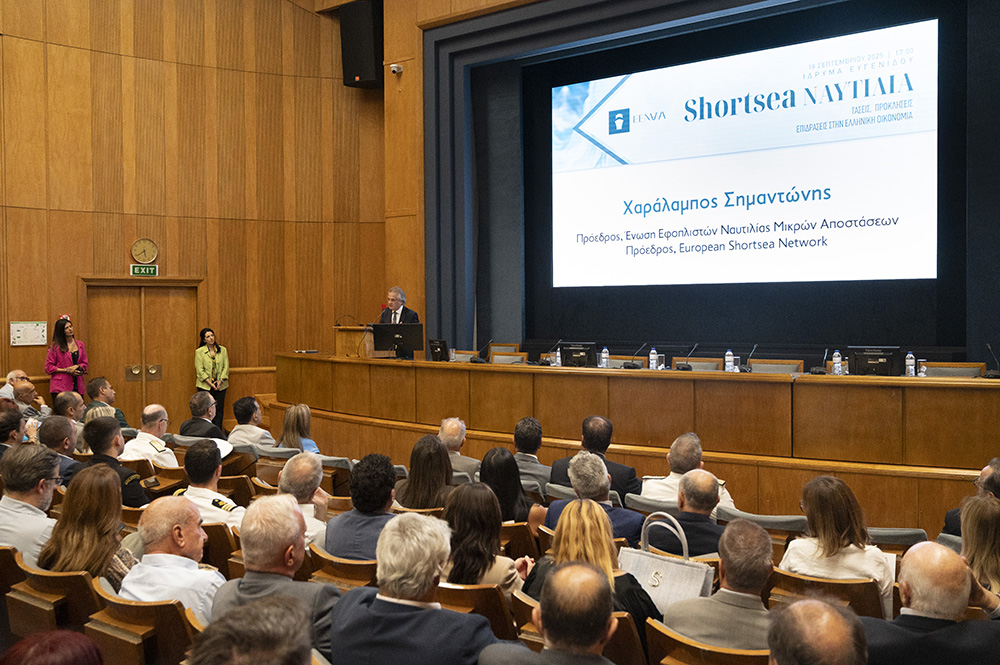
The results of the study “Shortsea Shipping in Domestic Transport: Trends, Challenges and Impact on the Greek Economy”, prepared by the Foundation for Economic and Industrial Research (IOBE), were presented to representatives of the maritime community by the Hellenic Shortsea Shipowners Association (EENMA) during an event held on Thursday, 18 September 2025, at the Eugenides Foundation.
The event was attended by representatives of the government, academia, the diplomatic corps, as well as numerous maritime institutions and organisations. Among those present were Giannis Kefalogiannis, Minister of Climate Crisis and Civil Protection; Domna Michailidou, Minister of Social Cohesion and Family; Stefanos Gkikas, Deputy Minister of Maritime Affairs and Insular Policy; Kostas Katsafados, Deputy Minister of Climate Crisis and Civil Protection; George Alexandratos, President of the Hellenic Chamber of Shipping; Elpi Petraki, President of WISTA International and Secretary General of EENMA; Nikolaos Liapis, President of ELINT and member of the EENMA Board; and Vice Admiral Tryfon Kontizas, Commandant of the Hellenic Coast Guard, among others.
The event was opened by Charalambos Simantonis, President of the Hellenic Shortsea Shipowners Association and President of the European Shortsea Network, who explained that EENMA commissioned the study in order to obtain a clear and evidence-based assessment of the economic footprint of domestic shortsea shipping.
He highlighted that the sector represents one of the key links within the national transport system, being responsible for the supply, fuel distribution, and coverage of the needs of Greece’s island regions, directly influencing their economic and social wellbeing. At the same time, the study identifies the challenges facing the sector, as well as opportunities that could strengthen its competitiveness both in Greece and within the European Union.
Introductory remarks were also delivered by Stefanos Gkikas, Deputy Minister of Maritime Affairs and Insular Policy; Georgios Larisis, representing the Minister of Development; and George Alexandratos, President of the Hellenic Chamber of Shipping.
The study was introduced by Professor Nikos Vettas, Director General of IOBE, and presented by Ilias Demian, Head of the Environmental Economics Department at IOBE and member of the research team.
Key Findings of the Study
According to the findings, the economic footprint of maritime freight transport in Greece (excluding international deep-sea shipping) amounted in 2023 to €914 million in GDP, supporting 8,300 full-time jobs, while its contribution to public revenues is estimated at €207 million.
Greece ranks 8th among the EU27, with 6.7% of the total cargo volume of European shortsea shipping handled by the domestic sector, highlighting its strategic importance for both the Greek and the European market.
Future Challenges
However, the study also highlights significant challenges for the sector’s future. The high average age of the fleet, the need to comply with the environmental requirements of the EU “Fit for 55” package, and the lack of infrastructure to support decarbonisation efforts create pressures on the competitiveness of shortsea shipping.
The study estimates that without additional policy interventions, the annual compliance cost with the new measures could reach €225 million by 2030, potentially leading to freight rate increases of up to 38.6% and revenue losses of approximately €140 million.
Policy Proposals
To address these challenges, the IOBE study proposes a set of policy measures centred on fleet renewal and modernisation, with emphasis on the adoption of low- or zero-emission technologies.
At the same time, investments are required in critical port infrastructure, including:
shore-side electricity supply (cold ironing)
alternative fuel bunkering infrastructure
intermodal terminals that enhance connectivity between shortsea shipping, rail, and road networks
The study also highlights the importance of dedicated financial instruments, drawing among others on EU Emissions Trading System (ETS) revenues and European funding programmes, to support the green transition of the sector.
The event concluded with remarks from participants and an open discussion, which provided additional insights for further actions and policy proposals.
More information: info@shortsea.gr
Photos: Maria Koukou